I’ve been spending a lot of time recently thinking about money. I’m betting you are too, since most Canadians are feeling the financial squeeze at unprecedented levels. And when you’re in a tight spot like this you can’t help but think about alternatives to where you spend your money, where you keep your money, and how other people are making money off you. Which has led me to take a closer look at credit unions in Canada and why I’ve previously had hang-ups with them.

I spent years working in banking from pensions to private investment. I know how the system works and who it works for. And I’ll be honest: for most of that time, I never seriously considered a credit union as an alternative. I held the same assumptions most Canadians do. Small. Local. Limited. Not really for people like me.
I was wrong about almost all of it.
This fall, I’ve decided I’m moving everything at my bank over to a credit union. The final nudge I needed came after I sat down with Lisa Colangelo, the CEO of YNCU, who spent decades working her way up through the banking system before choosing to leave it. She knows both worlds better than almost anyone. What she told me reframed a lot of things I thought I understood.
Here’s what I got wrong
The Myths Worth Dropping
Myth 1: Credit unions are small, local and technologically behind
This is the one I held onto longest, and it’s the most wrong.
The image most of us carry of a credit union is a single branch in a small town, probably with a bulletin board and a jar of lollipops at the teller window. That picture hasn’t been accurate for a long time.
YNCU alone spans the province of Ontario, with locations from Sault Ste. Marie and Timmins down through Kitchener, Waterloo, Toronto, Mississauga and Ottawa. And the ATM access goes well beyond that. Credit union ATMs are free to use for any credit union member across Canada. If you’re in British Columbia and need cash, you can walk into any credit union and access your account at no charge.

On the digital side, the gap between credit unions and banks has essentially closed. With YNCU you can open a new account in three minutes online. If you’re expecting to find a creaky web portal from 2004, you’re going to be surprised.
Myth 2: You have to belong to a specific group to join
This one has some historical truth to it, which is probably why it stuck around. Early credit unions were often bonded, meaning membership was restricted to people in a particular industry, union or community. Teachers, firefighters, postal workers, that kind of thing.

Most credit unions in Canada have opened up their membership. If you live in Ontario and want to bank with YNCU, you can. You don’t need to work in a specific field or belong to a particular community. You just need to want to.
Myth 3: Switching is a nightmare
This is the excuse I’ve been using for years. My mortgage. My investments. My bill payments, my line of credit, my locked-in RSP. The mental load of untangling all of that from one institution and rebuilding it somewhere else felt genuinely exhausting, so I just didn’t do it.
Here’s what I learned: it’s nowhere near as complicated as I convinced myself it was.

YNCU is introducing a program called Click Switch that’ll handle the transfer of your recurring payments in one step. Their team walks you through the process. You make a call or start the digital account opening online, and they do the heavy lifting from there.
I’m not saying it takes zero effort. I’m saying the effort I’d built up in my head was much larger than the actual task. That’s worth knowing before you use it as a reason to stay put.
Myth 4: Your money is less protected at a credit union than at a bank
This is the one that genuinely surprised me, and I say that as someone who has worked in financial services.
Most Canadians know that deposits at the big banks are protected by CDIC, the Canada Deposit Insurance Corporation, up to $100,000 per depositor per category of deposit.
What most Canadians don’t know is that provincially regulated credit unions in Ontario protect deposits up to $250,000 for unregistered products, and with unlimited coverage for registered products like RRSPs and TFSAs.
You read that correctly. Your money is more protected at an Ontario credit union than it is at a federally regulated bank. That’s not fancy marketing or a sales pitch. That’s the actual regulatory framework.
Myth 5: Credit unions don’t offer the investment and wealth products I need
If you have investments, a wealth advisor, an RRSP, a TFSA, life insurance, disability insurance, any of the financial products you associate with a full-service bank, credit unions offer those too.
YNCU has a dedicated wealth team. The full range of investment products is available. The products are the same. The structure of the institution around those products is different.
Myth 6: Credit unions aren’t as stable as banks
The stability question often comes up alongside the deposit protection question, so let me address them separately.
On deposits, as covered above, you’re actually better protected at an Ontario credit union than at a bank.
On institutional stability more broadly: credit unions in Canada are provincially regulated, have been operating for over 100 years, and collectively hold hundreds of billions in assets. The credit union system in Canada isn’t a fringe alternative. It’s a mature, established part of the financial landscape that more than a third of working-age Canadians are already part of.
So what actually is a credit union, and why does the structure matter?
A credit union is a member-owned financial cooperative. When you open an account, you become an owner, not a customer. It’s a legal and structural reality that changes how decisions get made.
At a bank, the institution answers to shareholders. The goal is profit growth, quarter over quarter, which is why your fees have a way of quietly increasing while your savings rate stays flat.
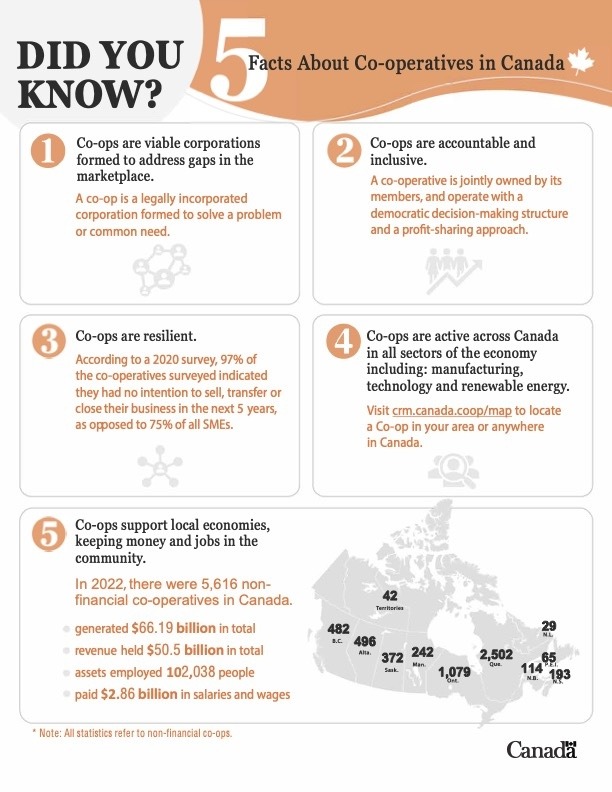
At a credit union, the institution answers to members. Profits go back to members in the form of dividends, lower fees, and better rates, and into the communities the credit union serves. That’s the cooperative model. It’s the same principle behind a farmers co-op or a housing co-op: the structure exists to serve the people in it.
This isn’t a new idea. It’s just one that most of us were never told we had access to.
The real reason most of us stay with the banks
Most of us never actually chose our bank. We just ended up there. Our parents banked there. Our first paycheque landed there. The name was on the arena where we watched the game, the billboard on the highway, the app we downloaded because it was the one we already had. Nobody sat down and made a decision.
The big banks spend at a scale that credit unions simply can’t match. Scotiabank paid a reported $800 million over 20 years to put their name on the building where Canadians watch the Leafs and the Raptors. Credit unions sponsor community rinks and local theatres. Both are sponsorships. The scale tells you everything about where the priorities sit.

The CEOs of Canada’s big banks took home between $13 million and $23 million each last year. The CEO of a large credit union might earn somewhere between $500,000 and $1 million. I guarantee you they’re not working any harder than each other. The only difference is who they’re accountable to. And we’ve been conditioned to assume that whoever gets paid more must be worth more. That’s worth questioning.

The result is that millions of Canadians are banking with institutions that are structurally designed to extract value from them, when an alternative that’s structurally designed to serve them has been sitting right there the whole time. Most of us never made a choice. We just ended up somewhere by default and stayed. It’s worth thinking about why, especially if you feel your values don’t align with where your money lives.

What to do if you’re curious
You don’t have to move everything at once. Lisa’s advice was simple: start with a conversation. Go to the website of a credit union in your province, call them, or walk into a branch. Ask what it would look like to move your banking over. See what they say.
If you’re in Ontario, YNCU is a good place to start. If you’re outside Ontario, every province has credit unions and they all operate on the same cooperative model.
And if you want to go deeper before you do anything, the full conversation with Lisa is embedded above. She’s spent her career on both sides of this and she’s generous with what she actually knows.
Frequently Asked Questions
In Ontario, credit union deposits are protected up to $250,000 for unregistered products, compared to $100,000 through the federal CDIC coverage that applies to banks. For registered products like RRSPs and TFSAs, Ontario credit union coverage is unlimited. So in practical terms, an Ontario credit union offers more deposit protection than a federally regulated bank.
The core difference is ownership. Banks are shareholder-owned and operate to generate profit for investors. Credit unions are member-owned cooperatives. Every account holder is an owner, which means profits are returned to members and communities rather than flowing to shareholders. Both offer the same range of financial products and services.
Most credit unions in Canada have open membership, meaning you don’t need to belong to a specific industry or community to join. Some credit unions still serve particular membership groups, but the majority have expanded to welcome anyone in their operating region.
Less hard than most people expect. Many credit unions have dedicated teams to help with the transition and tools that can transfer recurring payments automatically. The process typically starts with opening an account, which can be done online in minutes, and then migrating your products and payments over time with support from the credit union’s team.
Yes. Credit unions offer the full range of wealth and investment products including RRSPs, TFSAs, GICs, mutual funds, and insurance products. Most have dedicated wealth advisory teams.
Significantly less. The CEOs of Canada’s major banks earned between $13 million and $23 million in total compensation in 2025. The average credit union CEO salary in Ontario is approximately $86,000 a year. The difference reflects the fundamental structural difference between shareholder-driven and member-driven institutions.
Disclosure: This episode of What She Said was produced in partnership with YNCU. As always, all opinions are my own and cannot be bought. I was already over the big banks before this conversation started. If you are too, just know you have options.