True crime aficionados rejoice because the Redhead Murders documentary is here, and you’re going to want to catch it on Prime now!
In 1985, bodies began appearing along Interstate highways across the American South. Twenty-four women, eleven of them redheads, all strangled, all dumped roadside, nearly every week. Most were never identified. The investigation eventually petered out. The women were left without names, without justice, without anyone who would keep looking.
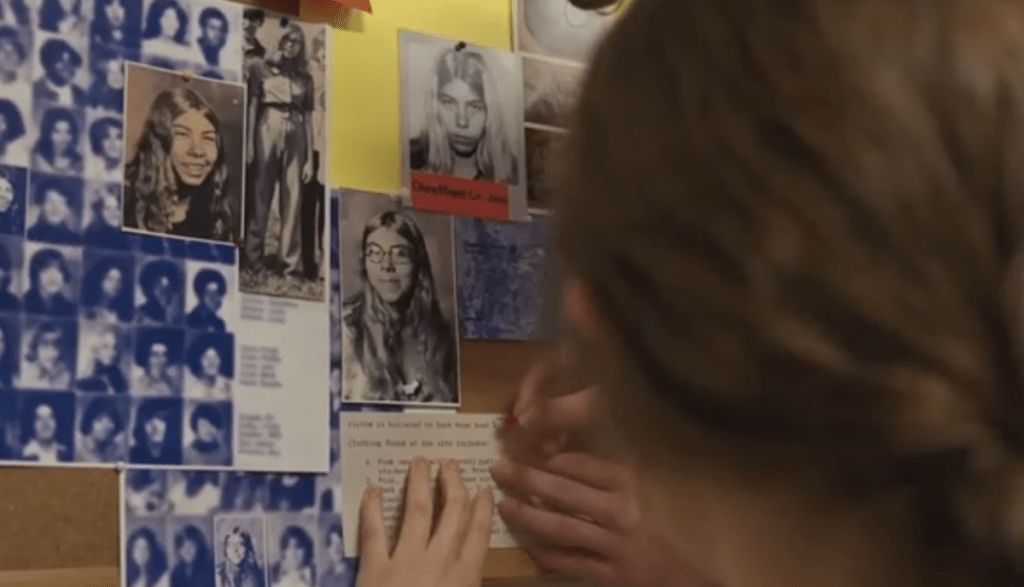
Three decades later, a high school sociology class in Elizabethton, Tennessee decided to finish it.
Murder 101, now streaming on Amazon Prime Video, is one of the most unusual true crime series in recent memory. Under the leadership of teacher Alex Campbell, a group of teenagers transformed their classroom into something closer to a forensics think tank, digging into official case files from the Tennessee Bureau of Investigation with a focus that shames the original investigators. Their motivation was simple and devastating: these women deserved voices. Most of them never even got names.
The Redhead Murders: What Happened
The Redhead Murders remain one of America’s most disturbing unsolved serial killer cases. Victims were predominantly young women, many of them sex workers or hitchhikers, which investigators later acknowledged contributed to the case receiving less attention than it deserved. Eleven had red hair, which gave the case its name. Bodies turned up beside Interstate highways across multiple states, always strangled, always roadside. The FBI and Tennessee Bureau of Investigation both worked it. It went cold anyway.

Only one victim survived. The students tracked her down and persuaded her to speak. Understandably, she did not want to revisit that horror. Thankfully, she did it anyway, and her testimony is one of the most powerful moments in the series.

What the Students Found
Working through every shred of available evidence, behavioural studies, and case files over the course of a full academic year, the class established that every murder involved strangulation and proximity to a highway, which led to the launch of the official Highway 7 Serial Killer Initiative. Eventually everything pointed back to a single suspect.
Officials shared a name: Jerry Leon Jones, a long-haul truck driver with a relatively high IQ whose routes consistently placed him near the dump sites. Investigators described him as wearing what criminologists call the mask of sanity, a term for individuals who present as completely normal while concealing violent behaviour. The series explores this concept in unsettling detail.

About the Redhead Murders Documentary Series
Murder 101, the title of the Redhead Murders documentary, is based on real events and draws on official case files from the Tennessee Bureau of Investigation. It takes place over the 2018 to 2019 academic year in Elizabethton, Tennessee, a small city in Appalachia.
The Scale of the Problem
- The FBI estimates there are between 25 and 50 active serial killers in the United States at any given time.
- The Highway Serial Killings Initiative, launched by the FBI in 2004, has linked over 850 victims to crimes committed along American highways and truck routes.
- Long-haul truck drivers are disproportionately represented among highway serial killer suspects, largely due to the mobility their work provides and the difficulty of tracking movements across state lines.
- Victims who are sex workers, hitchhikers, or otherwise marginalised are statistically less likely to have their cases actively pursued. Investigators have a term for this: the less-dead.
- As of 2024, more than 40% of homicides in the United States go unsolved. For female victims found in rural or highway locations, that number is significantly higher.
Sources: FBI Highway Serial Killings Initiative, Bureau of Justice Statistics, Violence Policy Center.
One question lingers after watching: what did these students’ parents think of the project? A sociology class that spent a year immersed in strangulation murders, unidentified victims, and a suspected serial killer. It is a reasonable question with no clean answer.
Hats off to these kids and their teacher. They gave these women a chance at identity that the justice system failed to provide.
Riveting, disturbing, and strangely hopeful.