Sometimes you just want to look cute without spending an hour wrestling with your inner radical. You want a sweater. Not a moral reckoning. Not a supply chain audit. A sweater. And yet here we are in 2026, where buying from Canadian clothing brands, or deciding not to, comes loaded with enough ethical subtext to exhaust even the most well-intentioned among us. If you have a conscience, getting dressed has become genuinely, absurdly difficult.
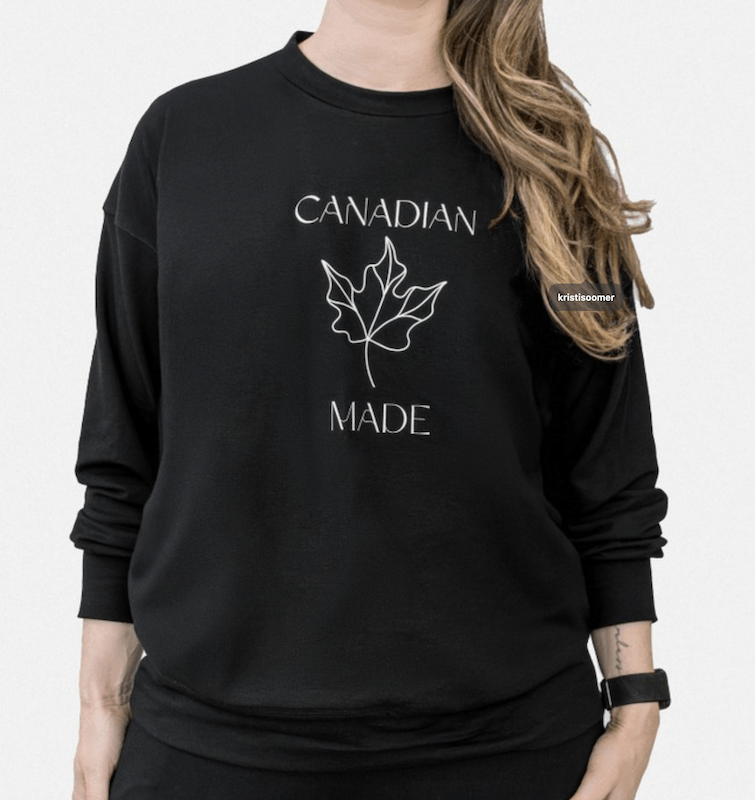
I spoke with Kristi Soomer, founder of Encircled, one of the most recognised Canadian clothing brands in the slow fashion space, and what she described was not a business struggling to find its footing. It was a business that had done everything right for thirteen years and was being taken apart by forces entirely outside its control. That distinction matters more than most of the buy-local conversation currently acknowledges.
The $100 Gap Nobody Wants to Talk About
Here is the actual problem with Canadian clothing brands right now, stated plainly: you can buy a maple leaf sweatshirt for Canada Day, made in China, shipped across an ocean, for $20. Or you can buy the same garment made here, from a brand paying living wages, knitting fabric in Toronto, holding B Corp certification, and sourcing responsibly, for $120. Same sweater. Hundred dollar gap. And your budget, not your conscience, will likely make the final call.
And herein lies the problem. The system has been deliberately constructed to make the ethical option feel like a luxury purchase.
Canadian clothing brands like Encircled are not overcharging. They are accurately pricing what it actually costs to make something properly. The $20 option is not a miracle of manufacturing efficiency. It is a bill that someone else already paid, usually a garment worker in a country where unions are suppressed, wages are a fraction of a living rate, and in the worst cases, where conditions cross into something we should be willing to name directly: exploitation that in some supply chains amounts to slavery. The cost did not disappear. It was transferred.
When Kristi notes that roughly 98 percent of apparel brands globally do not pay living wages, that is not a fringe statistic. That is the business model underpinning most of what hangs on the racks at your average mall, and likely your closet. Fast fashion’s price point is not competitive. It is subsidised by suffering that happens far enough away that we are not required to look at it.
What Trump’s Trade War Actually Did to Canadian Clothing Brands
The tariff situation facing Canadian clothing brands in 2026 did not create the ethical consumer dilemma. It accelerated it brutally, at exactly the wrong moment.
The collapse of the de minimis exemption, which had allowed packages under $800 USD to cross into the United States duty free, hit Canadian apparel brands like Encircled with immediate, severe consequences. For a brand where American customers represented up to 50 percent of monthly revenue, losing frictionless US access became an existential threat.
Then there is the yarn forward rule, which sounds technical until you understand what it means in practice. To qualify for duty free treatment under the Canada-United States-Mexico Agreement, the yarn used to knit fabric must be spun in a CUSMA country. Encircled knits roughly 60 percent of its fabric in Toronto, which is already exceptional, but uses imported yarns. That means the brand that is literally manufacturing in Canada does not fully qualify as Canadian enough under the rules designed to protect Canadian manufacturing. The circularity of that is almost impressive.
The result: a 35 percent emergency tariff on top of base duties that already ran as high as 32 percent for some garments. Going from zero to approximately 63 percent overnight. For a small brand without the legal teams and logistics infrastructure of a Canada Goose, the only viable response was to shut off US shipping entirely and start calculating whether storing inventory in an American warehouse was even financially survivable.
Meanwhile, the Canadian consumer is being squeezed from every direction by the same trade war. Grocery bills are up. Housing costs are not coming down. Essentials are eating a larger share of every paycheque. And when the budget gets tight, discretionary spending is where the cuts happen first, and cheap and cheerful wins over Canadian and responsible almost every time. Not because people do not care. Because they are stretched, and the system offers them an easy out at every turn.
The Government Response: We Need Policy, Not Policing
When Kristi describes the federal response to what is happening to small Canadian clothing brands, the word she keeps returning to is loans. Not grants. Not emergency relief designed to offset the cost of a trade war the businesses had no hand in starting. Loans. More debt, offered to companies that in many cases are still carrying their COVID-era loans, to navigate a crisis manufactured by geopolitical conditions entirely outside their control.
The apparel sector has been largely absent from the policy conversation. Lumber gets named. Auto manufacturing gets named. Small Canadian clothing brands, many of them employing under ten people, paying living wages, supporting local knitting mills, and building the kind of supply chain Canadians say they want, get a paragraph about potential funding programs with details to follow.
What these brands actually need is policy, not policing. The government has shown some appetite for regulating what can claim to be Canadian made, which is useful as far as it goes. But cracking down on misleading labels while the structural conditions that make honest Canadian manufacturing uncompetitive go unaddressed is exactly backwards. You cannot enforce your way to a healthy domestic apparel industry. You build one with grants, not loans. With export support that is actually open and funded rather than quietly closed. With trade policy that considers what it costs a small maker to develop a new market and provides real resources toward that.
The EU’s General Product Safety Regulations have already shut Canadian apparel brands out of European shipping entirely, another market gone without meaningful federal support to navigate it. The conversation about buying Canadian cannot be serious if the government is not simultaneously removing the barriers that make selling Canadian so punishingly difficult.
Why Canadian Clothing Brands Are Not the Problem. You Are Not Either.
Here is what I want to say directly to anyone who has ever stood in a shop or scrolled online and felt vaguely terrible about not being able to justify the $120 sweater: the guilt you are carrying is a policy failure that has been successfully redirected onto your credit card decision.
The conversation about supporting Canadian clothing brands too often ends up as a consumer responsibility argument, as though if enough individuals made better choices at checkout, the structural problems would resolve themselves. They would not. Individual purchasing decisions cannot fix a tariff regime. They cannot reopen export grants or compel the federal government to treat small apparel manufacturers as a sector worth protecting explicitly rather than folding them into a general small business paragraph.
What individual choices can do is keep specific businesses alive long enough for the structural conditions to improve, or not. That is meaningful. It is worth doing when you can. But it is a much more modest ask than the buy-local conversation typically frames it as, and we should stop pretending it is a solution to a problem that requires policy intervention and genuine government commitment to actually solve.
What Encircled Is Actually Up Against
Thirteen years. B Corp certified. Fabric knitted in Toronto. Living wages. Petite, regular, and tall inseams because they actually thought about who wears their clothes. A resale platform so that the garments they make stay in circulation rather than landfill. And right now Kristi Soomer is seriously weighing whether to put inventory in a US warehouse, in a country whose government has just demonstrated exactly how quickly it will upend the conditions Canadian businesses depend on, because it is the only way to keep serving the customers she has spent thirteen years building relationships with.

That is not a story about a business that made the wrong choices. That is a story about what happens to businesses that make all the right choices when the conditions around them collapse.
The podcast conversation is worth your time if you want to understand the mechanics of what is actually happening on the ground for Canadian clothing brands right now. The yarn forward explainer alone is something every person who has ever bought or wanted to buy Canadian fashion should hear.