
By Anne Brodie
In 1984, the Jessop family lived in a green and white farmhouse, formerly Poker’s Paradise Antiques, set back from Leslie Street, the driveway lined by big trees. The youngest child, nine-year-old Christine went missing on Oct 3. and sadly, three months later, her little body was found abused, raped and murdered in a field in Durham Region. Her murder had an enormous effect on the area; unbelievable evil had crept into the peaceful rural hamlet of Queensville.
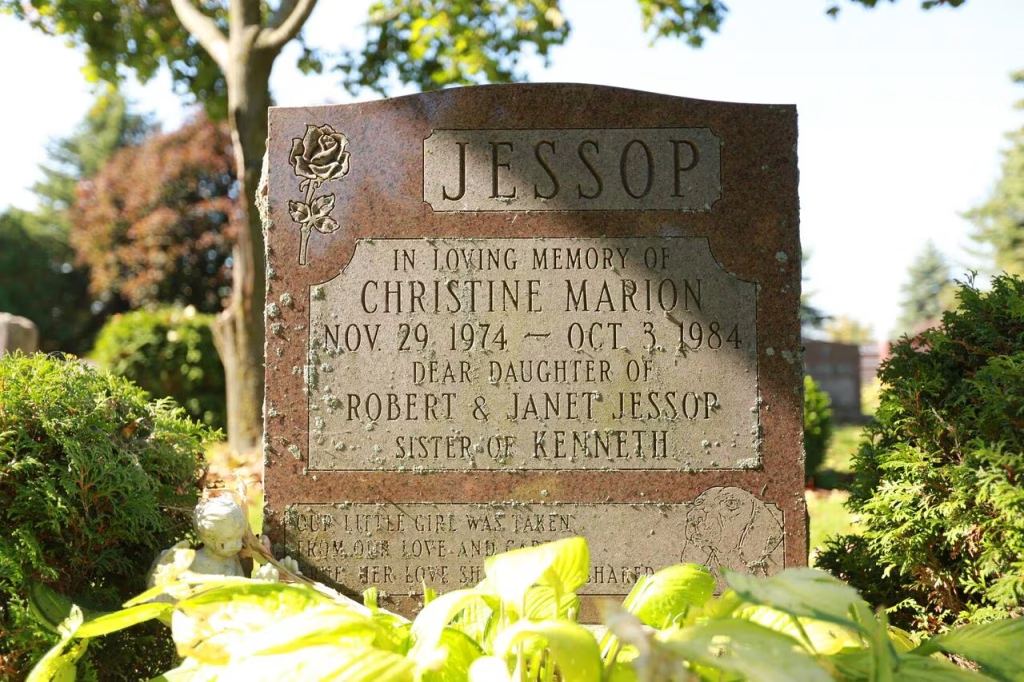
Missteps by law enforcement including arresting two innocent men and mishandling evidence are the focus of filmmaker Folklaur Chevrier’s powerful series The Christine Jessop Story streaming on Netflix (ranked #2 within its first two days on the platform). It gets to the heart of the mess made and opportunities lost in the investigation, and why it took so long to break the case. She spoke with living family members, and used extensive, rich archival footage.

Filmmaker Folklaur Chevrier
Chevrier believes storytelling is “a bridge to justice, understanding, and shared human truth” and put her all into this important work. What She Said’ Anne Brodie interviewed the actor, model and committed documentarian.
Anne Brodie – I was keenly aware of Christine’s brutal murder in 1984 as I Iived nearby at the time. It was deeply shocking that a little girl would be abducted, beaten and murdered and tossed in a field. The community held its breath through her disappearance and then that awful discovery.
Folklaur Chevrier – Anne, thank you for sharing that. Hearing how close you were to Christine’s story – literally down the street – really underlines how deeply this case touched the community. That sense of something unthinkable happening in your midst, and remaining unresolved for so long, is something I’ve carried with me throughout this process. It reminds me that we’re not just revisiting a case, we’re stewarding a collective memory with care and responsibility.
FC – Thank you, Anne, I really appreciate that. For me, this story was never about crime as spectacle. It was about Christine- a child with a life, a family, a future – and about the profound injustice her loved ones endured for decades. When I was entrusted with the opportunity to tell this story, I felt a deep responsibility to approach it with care, rigor, and compassion. I saw my role as one of stewardship- not just recounting events, but ensuring Christine is remembered for who she was and that her family’s voice was honoured with dignity and truth.
AB – The tone is balanced. It’s informative and shows what happened that we knew about and so much we didn’t. How did you get breakthroughs?
FC – Breakthroughs came from patience, trust, and listening. Some of the most critical insights were not in documents or court records but in conversations with people who had carried silence and grief for decades. We approached every interview with empathy, understanding that we were entering sacred, painful spaces. That combination of journalistic rigor and emotional care allowed us to uncover perspectives that had not been fully seen or understood before.
AB – You show us how law enforcement failed the family and the community. Were you concerned about bringing that forward?
FC – Certainly, we approached it with seriousness and humility. The intention was never to sensationalize or assign blame for its own sake. It was to illuminate where systems failed Christine, her family, and the community, and how those failures shaped the decades-long pursuit of justice. Accountability matters, but so does fairness. Every decision was guided by truth with integrity.
AB – How did they manage a cover-up in such a closely watched case?
FC – It’s a combination of human error, institutional pressures, and the culture of policing at the time. Information was siloed, investigations were fragmented, and biases went unchecked. Often what appears as concealment is the cumulative result of poor decisions under pressure rather than intentional malice. Revisiting these stories helps us learn from those mistakes and hold systems accountable.
The Crave series is now on Netflix.
